
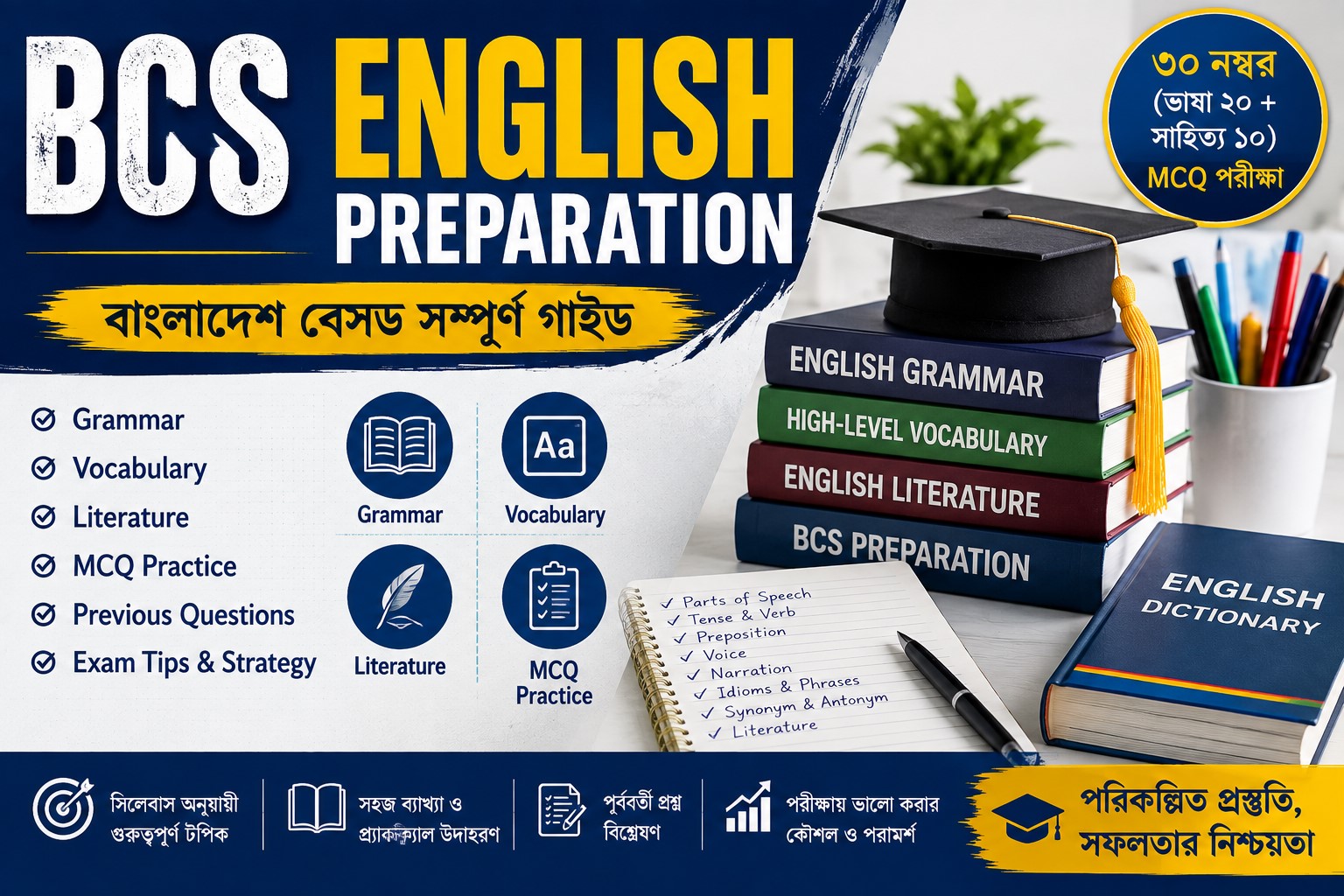
English is one of the most important subjects in the Bangladesh Civil Service (BCS) examination. Many candidates spend a lot of time memorizing difficult vocabulary, but BCS English preparation is much more effective when grammar, vocabulary, sentence structure, and literature are studied according to the official syllabus.
For the 50th BCS preliminary examination, the Bangladesh Public Service Commission (BPSC) revised the marks distribution. English Language and Literature was allocated 30 marks, while the preliminary examination remained a 200-mark MCQ test. The latest official syllabus divides English into Language (20 marks) and Literature (10 marks). Because BPSC may revise the structure for a future BCS, candidates should always compare their preparation with the latest official circular and syllabus.
This guide is designed specifically for Bangladesh BCS candidates and focuses on what to study, how to study it, which topics deserve priority, and how to turn English preparation into a scoring advantage.
BCS English Preparation at a Glance
| Area | What to Study |
|---|---|
| Parts of Speech | Noun, Pronoun, Verb, Adjective, Adverb, Preposition, Conjunction |
| Determiners | Articles and other determiners |
| Verb | Finite, non-finite, linking verb, phrasal verb, modals |
| Idioms & Phrases | Meaning, identification and usage |
| Clauses | Principal and subordinate clauses |
| Grammar Correction | Tense, verb, preposition, number, gender, agreement |
| Sentence | Simple, compound and complex sentences |
| Transformation | Voice and degree of comparison |
| Words | Meaning, synonym, antonym and spelling |
| Word Formation | Prefixes, suffixes and parts of speech |
| Composition | Paragraph, letter and application terminology |
| Literature | Writers and literary works from the Elizabethan period to the 21st century |
| Quotations | Important quotations from drama and poetry |
The above areas are based on the English Language and Literature syllabus published by BPSC.
Understanding the BCS English Syllabus
Before buying books or starting a vocabulary list, understand how the subject is organized.
The latest published syllabus for the 50th BCS preliminary test allocates 30 marks to English Language and Literature:
- Part I: Language — 20 marks
- Part II: Literature — 10 marks
The language portion includes Parts of Speech, Idioms and Phrases, Clauses, Corrections, Sentences and Transformations, Words, and Composition. The literature portion focuses on English literary writers from the Elizabethan period to the 21st century and quotations from drama and poetry.
This division gives you an important preparation clue: grammar and language should receive the largest share of your regular practice, while literature should be studied systematically rather than randomly.
1. Parts of Speech
Parts of Speech is the foundation of English grammar. A candidate who understands how words function inside a sentence will find many other grammar topics easier.
The official syllabus covers:
- Noun
- Determiner
- Gender
- Number
- Pronoun
- Finite Verb
- Non-finite Verb
- Linking Verb
- Phrasal Verb
- Modals
- Adjective
- Adverb
- Preposition
- Conjunction
For example:
The young teacher speaks clearly.
Here:
- teacher — noun
- young — adjective
- speaks — verb
- clearly — adverb
Do not study Parts of Speech only as definitions. Practice identifying the function of a word within a sentence.
2. Noun, Pronoun, Gender and Number
These basic areas can become confusing when questions are designed around exceptions.
For Nouns, revise:
- Common and proper nouns
- Countable and uncountable nouns
- Singular and plural forms
- Collective nouns
- Possessive forms
For Pronouns, pay attention to:
- Personal pronouns
- Possessive pronouns
- Reflexive pronouns
- Relative pronouns
- Demonstrative pronouns
- Indefinite pronouns
Gender and Number are also explicitly included in the official syllabus.
A good way to prepare is to solve questions rather than memorizing long lists of rules.
3. Verb and Its Different Forms
Verbs deserve special attention because they connect several important areas of BCS English grammar.
Study:
- Finite verbs
- Transitive verbs
- Intransitive verbs
- Non-finite verbs
- Participles
- Infinitives
- Gerunds
- Linking verbs
- Phrasal verbs
- Modals
These topics are specifically mentioned in the BPSC syllabus.
For example:
She enjoys reading.
Here, reading functions as a gerund.
Compare that with:
The girl is reading a book.
Here, reading is part of the verb phrase.
Understanding such differences is more useful than simply memorizing definitions.
4. Tense and Verb Correction
Tense is one of the areas where candidates can improve through repeated practice.
Revise the relationship between:
- Subject
- Main verb
- Auxiliary verb
- Time expression
- Sentence meaning
For example:
He goes to college every day.
The phrase every day indicates a habitual action, so the sentence uses the present simple tense.
You should also practice sentences containing:
- Since
- For
- Already
- Yet
- Just
- Yesterday
- Last year
- Tomorrow
- By the time
- When
- While
The official syllabus specifically includes corrections involving tense and verbs.
5. Preposition
Prepositions often cause problems because one Bangla expression does not always correspond to one English preposition.
Important prepositions include:
- in
- on
- at
- by
- for
- from
- to
- with
- of
- into
- among
- between
- beside
- besides
Instead of memorizing isolated combinations, create examples.
For instance:
interested in
good at
depend on
afraid of
consist of
This type of practice helps you remember preposition usage naturally.
6. Subject-Verb Agreement
Subject-Verb Agreement is another high-value grammar topic.
Compare:
He works hard.
and
They work hard.
You should pay particular attention to words such as:
- Each
- Every
- Everyone
- Everybody
- Neither
- Either
- One
- None
Questions may be designed to make you focus on the actual grammatical subject rather than the nearest noun.
The official BCS syllabus explicitly includes Subject-Verb Agreement under correction.
7. Idioms and Phrases
BCS candidates should maintain a separate notebook for idioms and phrases.
Do not try to memorize hundreds of expressions in one sitting. Start with common expressions and revise them repeatedly.
For example:
A blessing in disguise
Something that appears bad at first but eventually produces a good result.
Once in a blue moon
Something that happens very rarely.
At sixes and sevens
A state of confusion or disorder.
The BPSC syllabus includes the meaning, kinds and identification of phrases.
When learning an idiom, record:
Idiom → Meaning → Example
That three-part method is easier to revise later.
8. Clauses
Clause-related questions become easier when you first understand the difference between an independent and dependent structure.
The official syllabus includes:
- Principal Clause
- Subordinate Clause
- Noun Clause
- Adjective Clause
- Adverbial Clause and its types
For example:
I know that he is honest.
The highlighted part functions as a noun clause.
Similarly:
The man who came here yesterday is my uncle.
The highlighted part functions as an adjective clause.
Practice identifying the function of the clause instead of simply memorizing terminology.
9. Sentence and Transformation
The BCS syllabus includes three major sentence structures:
- Simple
- Compound
- Complex
It also includes:
- Active Voice
- Passive Voice
- Positive Degree
- Comparative Degree
- Superlative Degree
Simple
He worked hard to succeed.
Complex
He worked hard so that he could succeed.
Compound
He worked hard, and he succeeded.
Understanding how sentence structures relate to each other is more useful than memorizing isolated transformation formulas.
10. Voice
Active and Passive Voice are standard grammar areas for competitive examinations.
Example:
Active:
The committee approved the proposal.
Passive:
The proposal was approved by the committee.
When studying Voice, practice one tense at a time. Start with simple present and simple past, then move toward more complicated structures.
Pay attention to:
- Object
- Auxiliary verb
- Past participle
- Tense
- Subject/object relationship
11. Degree of Comparison
The official syllabus includes:
- Positive Degree
- Comparative Degree
- Superlative Degree
Example:
Rahim is as tall as Karim.
Rahim is taller than Karim.
Rahim is the tallest student in the class.
Focus on both the grammatical structure and the meaning of the sentence.
12. Synonyms and Antonyms
Vocabulary is not just about memorizing difficult English words.
For BCS preparation, build vocabulary around:
- Synonyms
- Antonyms
- Word meanings
- Spelling
- Usage
- Word formation
These areas are directly included in the official syllabus.
A practical method is to learn 10–15 useful words per day and revise older words before adding new ones.
For example:
Abandon
Synonym: Leave
Antonym: Retain
Ancient
Synonym: Old
Antonym: Modern
The important thing is not the number of words you read. It is how many you can actually remember when you see them in an MCQ.
13. Spelling
Spelling questions can be deceptively easy.
Candidates often recognize a word but fail to notice a small difference between two options.
Maintain a list of commonly confused spellings.
For example:
- Accommodation
- Necessary
- Separate
- Government
- Privilege
- Occurrence
- Maintenance
- Receive
Write difficult words several times instead of only reading them.
14. Prefixes and Suffixes
The official syllabus also includes formation of new words by adding prefixes and suffixes.
Understanding word formation can help you recognize unfamiliar vocabulary.
For example:
un + happy = unhappy
kind + ness = kindness
develop + ment = development
You do not need to memorize every possible prefix and suffix. Learn common patterns and practice them through examples.
15. Composition
The BCS preliminary syllabus mentions the names of parts of:
- Paragraphs
- Letters
- Applications
This is different from preparing for the written English paper, where actual composition and writing skills become much more important.
Therefore, preliminary candidates should understand basic terminology without spending disproportionate amounts of time on writing practice.
BCS English Literature Preparation
Many candidates become confused when they start English Literature because the subject contains a large number of writers, works and literary facts.
The solution is to study literature chronologically.
The official syllabus covers literary writers from the Elizabethan period to the 21st century, along with quotations from drama and poetry of different ages.
16. Elizabethan Literature
Begin with major writers and their important works.
Topics worth knowing include:
- William Shakespeare
- Christopher Marlowe
- Edmund Spenser
- Francis Bacon
Do not attempt to memorize every detail about every writer.
For each important writer, make a short note:
Writer → Major works → Literary period → Important fact
17. Seventeenth and Eighteenth Century Literature
After the Elizabethan period, move gradually through later literary periods.
Focus on major names rather than obscure facts.
Important areas include:
- Metaphysical poetry
- Restoration literature
- Augustan literature
- Major poets and prose writers
- Important dramas
The goal is to build a timeline in your mind.
18. Romantic Literature
Romantic literature is especially important for competitive-exam preparation.
Know the major Romantic poets, including:
- William Wordsworth
- Samuel Taylor Coleridge
- Lord Byron
- Percy Bysshe Shelley
- John Keats
For each writer, connect the name with major works and commonly asked literary facts.
For example:
William Wordsworth → Lyrical Ballads → Romantic poetry
This association-based method is easier to revise than a long paragraph about the writer.
19. Victorian Literature
Next, study the major Victorian writers.
Important names include:
- Alfred Lord Tennyson
- Robert Browning
- Charles Dickens
- Thomas Hardy
- George Eliot
- Matthew Arnold
Again, focus on writer + work + period + key fact.
20. Modern and Twentieth-Century Literature
Your literature preparation should continue into modern literature because the official syllabus extends to the 21st century.
Give attention to major writers, literary movements and well-known works.
Do not study literature as an endless collection of isolated MCQs. Try to understand the broad timeline:
Elizabethan → Restoration/Augustan → Romantic → Victorian → Modern → Contemporary
Once that framework is clear, individual writers become much easier to place.
21. Quotations
The official syllabus includes quotations from drama and poetry of different ages.
For quotation-based questions, identify:
- Who said/wrote it?
- From which work?
- What is the context?
- Which literary period does it belong to?
Avoid trying to memorize huge passages. Focus on recognizable and frequently studied quotations.
BCS English Preparation Strategy
Knowing the syllabus is only the first step. The next question is how to turn it into a realistic study plan.
A useful sequence is:
Step 1 — Build the Grammar Base
Start with:
- Parts of Speech
- Noun and Pronoun
- Verb
- Tense
- Preposition
- Subject-Verb Agreement
Step 2 — Move to Applied Grammar
Then study:
- Idioms & Phrases
- Clauses
- Voice
- Sentence Transformation
- Degree
- Correction
Step 3 — Build Vocabulary
Study:
- Synonyms
- Antonyms
- Meaning
- Spelling
- Prefixes
- Suffixes
Step 4 — Study Literature
Create a chronological literature notebook.
Step 5 — Solve Questions
Finally, combine everything through previous BCS questions and timed MCQ practice.
A 30-Day BCS English Study Plan
If you want a focused one-month plan, the following structure can work well.
| Days | Focus |
|---|---|
| 1–3 | Parts of Speech |
| 4–5 | Noun, Pronoun, Gender & Number |
| 6–8 | Verb and Non-finite Verb |
| 9–11 | Tense & Verb Correction |
| 12–13 | Preposition |
| 14 | Subject-Verb Agreement |
| 15–16 | Idioms & Phrases |
| 17–18 | Clauses |
| 19 | Sentence Structure |
| 20 | Voice |
| 21 | Degree |
| 22 | Sentence Correction |
| 23 | Synonym & Antonym |
| 24 | Spelling |
| 25 | Word Formation |
| 26 | Composition-related topics |
| 27 | Elizabethan to Romantic Literature |
| 28 | Victorian & Modern Literature |
| 29 | Quotations + Literature Revision |
| 30 | Full English Mock Test + Error Review |
This is not a mandatory routine. If your grammar foundation is weak, spend more time on grammar and reduce the literature time initially.
Daily BCS English Routine
A practical daily routine could look like this:
30 minutes — Grammar
Learn or revise one topic.
30 minutes — MCQ Practice
Solve topic-based questions.
20 minutes — Vocabulary
Learn new words and revise old ones.
20 minutes — Literature
Study writers, works and literary periods.
20 minutes — Mistake Review
Go through questions you got wrong.
This final step is often neglected. Yet your mistakes provide a much better indication of your weak areas than simply counting how many questions you have solved.
How to Use Previous BCS Questions
Previous questions should not be treated as an answer bank.
Suppose you encounter a question about a preposition and get it wrong.
Do not simply write:
Correct answer: in
Instead, note the relevant usage and create two or three examples.
The same principle applies to:
- Tense
- Voice
- Narration
- Idioms
- Synonyms
- Literature
This turns one question into a learning opportunity.
How to Improve BCS English Vocabulary
Vocabulary improvement takes time, so consistency matters more than intensity.
Try this simple system:
Day 1
Learn 10 new words.
Day 2
Revise yesterday’s 10 and add 10 more.
Day 3
Review the previous 20 and add another 10.
At the end of each week, test yourself without looking at the answers.
Also learn words in groups.
For example:
Important → Significant → Notable → Crucial
Seeing related words together creates stronger associations.
How to Prepare English Literature Efficiently
Literature can consume a lot of preparation time if you do not have a system.
Create a table like this:
| Writer | Period | Important Work | Key Fact |
|---|---|---|---|
| Shakespeare | Elizabethan | Hamlet | Major dramatist |
| Wordsworth | Romantic | Tintern Abbey | Romantic poet |
| Charles Dickens | Victorian | Oliver Twist | Major novelist |
| T. S. Eliot | Modern | The Waste Land | Modernist poet |
Keep expanding the table as you study.
The purpose is not to create an encyclopedia. It is to create a quick-revision map.
Common Mistakes in BCS English Preparation
1. Memorizing grammar without understanding it
A memorized rule may disappear when the question is presented in an unfamiliar form.
2. Ignoring vocabulary
Strong grammar alone does not cover the entire English syllabus.
3. Studying only literature
Literature is important, but the language portion also deserves serious attention.
4. Collecting too many books
More books do not automatically mean better preparation.
5. Not revising mistakes
Wrong answers are useful only when you understand why you got them wrong.
6. Spending too much time on one topic
BCS preparation involves ten preliminary subjects. English should receive consistent attention without taking over your entire study schedule.
How to Prepare BCS English If Your English Is Weak
If your English foundation is poor, do not start with advanced literature or difficult vocabulary.
Start with:
Basic Grammar → Sentence Structure → Common Vocabulary → MCQ Practice
Spend the first few weeks strengthening basic grammar.
For example:
Week 1
- Parts of Speech
- Noun
- Pronoun
- Verb
Week 2
- Tense
- Preposition
- Subject-Verb Agreement
- Correction
Week 3
- Voice
- Clauses
- Transformation
- Idioms
Week 4
- Vocabulary
- Literature
- Previous questions
- Mock tests
Once the basics become comfortable, difficult questions become much less intimidating.
BCS English Preliminary vs Written English
One important distinction should not be overlooked.
BCS Preliminary English is an MCQ-based section of the preliminary test, whereas English in the BCS written examination is a much broader test of actual English writing and comprehension.
The BPSC written syllabus for compulsory English includes areas such as reading comprehension, summary writing, letter writing, essay writing and translation. The compulsory English written paper is 200 marks.
Therefore, candidates should not use exactly the same preparation strategy for preliminary and written exams.
For preliminary:
Grammar + Vocabulary + Literature + MCQ
For written:
Comprehension + Writing + Grammar + Translation + Analysis
Best Way to Revise Before the BCS Preliminary Exam
During the final stage, stop trying to learn everything from the beginning again.
Instead, revise:
- Your grammar notes
- Vocabulary lists
- Difficult idioms
- Common spelling mistakes
- Important literature facts
- Previous questions
- Mock-test mistakes
Create a Final Revision Notebook containing only information you repeatedly forget.
This notebook can become much more useful during the final week than a 500-page grammar book.
Frequently Asked Questions
How many marks is English in the BCS preliminary exam?
In the 50th BCS preliminary syllabus, English Language and Literature was allocated 30 marks. The English section was divided into 20 marks for Language and 10 marks for Literature.
What are the most important English topics for BCS?
Start with Parts of Speech, Verb, Tense, Preposition, Subject-Verb Agreement, Idioms & Phrases, Clauses, Sentence Transformation, Voice, Vocabulary and Spelling. These areas are explicitly included in the BPSC syllabus.
Is English Literature important for BCS?
Yes. Literature is a separate part of the English syllabus. The official syllabus covers writers from the Elizabethan period to the 21st century and quotations from drama and poetry.
How should I study vocabulary for BCS?
Study a manageable number of words every day, revise them frequently, and learn synonyms, antonyms, meanings and spelling together.
Should I solve previous BCS English questions?
Absolutely. Previous questions help you understand the style and level of questions and reveal which areas need more practice.
Can I prepare BCS English in one month?
You can make substantial progress in one month if you already have a basic foundation. If your English is weak, one month can build the foundation, but longer-term revision and practice will be more effective.
Is BCS written English the same as preliminary English?
No. The preliminary test focuses on MCQs covering language and literature, while the written English paper tests skills such as comprehension, summary, letter writing, essay writing and translation.
Final Thoughts
Effective BCS English Preparation does not require memorizing every grammar rule or every English literary fact you can find. What matters is knowing the official syllabus, identifying high-priority areas, practicing questions regularly, and revising your mistakes.
For the latest published 50th BCS preliminary syllabus, English carried 30 marks, with 20 marks in Language and 10 marks in Literature. The syllabus specifically covers grammar, idioms and phrases, clauses, sentence transformation, vocabulary, spelling, word formation, composition terminology and English literature.
A simple preparation formula is:
Understand the rule → Practice questions → Find your mistakes → Revise → Test yourself again
If you follow that cycle consistently, English can become one of the more manageable sections of your BCS preliminary preparation.
Official source: The latest BCS preliminary syllabus published by the Bangladesh Public Service Commission should be checked whenever a new BCS circular is released, because subject-wise marks or syllabus details can be revised.