
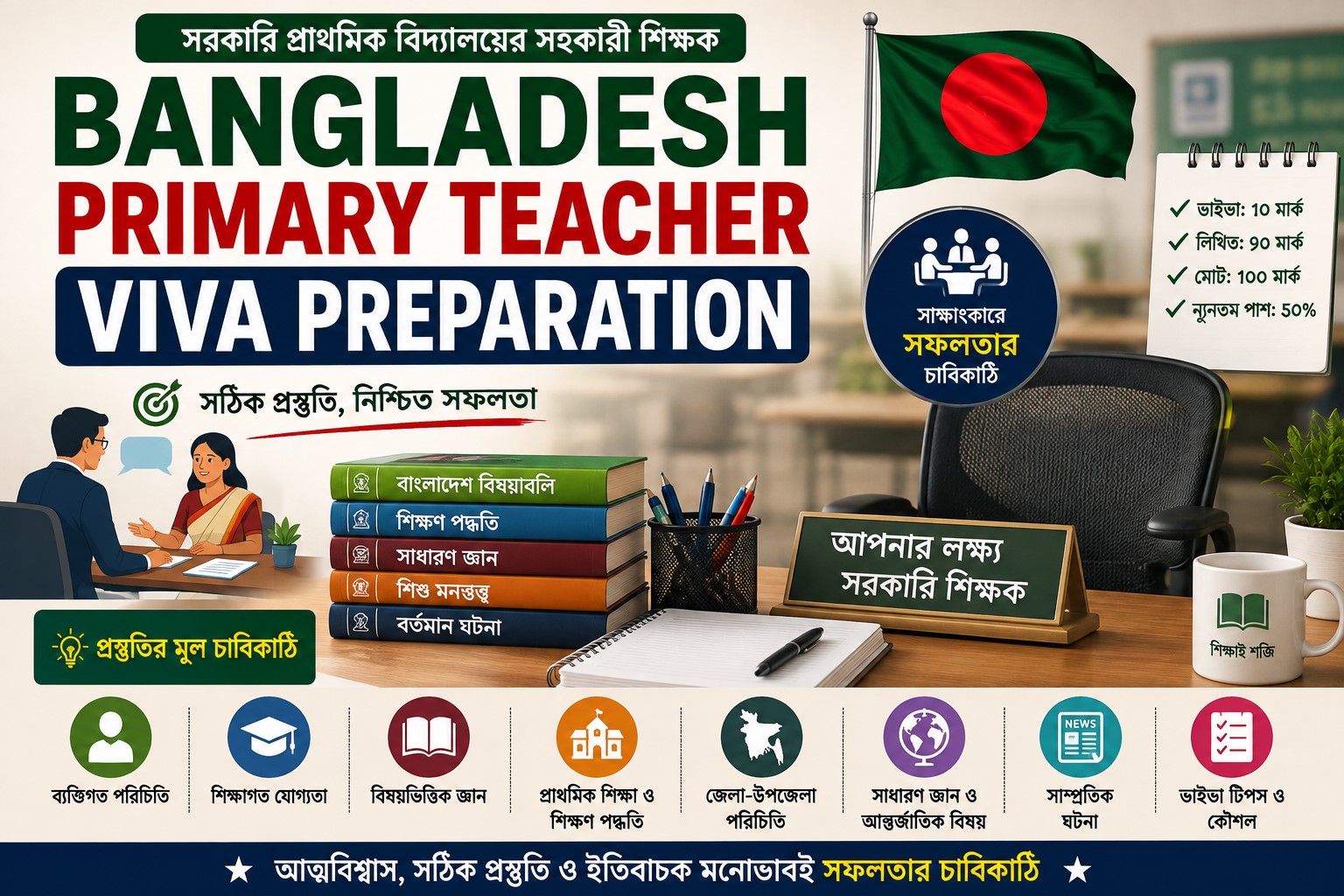
If you have cleared the written exam for the Bangladesh Primary Assistant Teacher Recruitment, the next step is the viva voce. This is an important part of the primary teacher interview process. Many feel that the viva can be harder than the written test. This is because there is not a set question paper for it. The interview panel can ask a wide range of questions in this round. You might get questions about your education, your personal information, your district, current events, teaching knowledge, and things you should know as a primary teacher. The kind of questions in this stage can be just about anything related to you and your job as a teacher.
This Bangladesh Primary Teacher Viva Preparation Guide 2026 is for people who want to be a primary teacher. It tells you how to get ready for the viva, what papers you need to be in hand, what kind of questions will come up, how to talk about yourself, and what to say for typical teaching questions. It also points out mistakes to stay away from.
Under the Government Primary School Teacher Recruitment Rules, 2025, people have to take a recruitment exam for the primary school teacher job. This exam has two parts. The written exam is worth 90 marks. There is an oral exam worth 10 marks. The exams together add up to 100 marks. A candidate must get at least 50% marks in both the oral exam and the written exam.
The Directorate of Primary Education (DPE) put out an official notice about the assistant-teacher oral exam on January 22, 2026. A day before, on January 21, 2026, DPE gave a list of the people picked for this oral exam.
If you are getting ready for the next step, this guide will help you. You can use your good results from the written exam to give a strong viva.
Primary Teacher Viva 2026 at a Glance
Before you start to make your own questions, you need to know what the basic structure is.
বিষয় | তথ্য |
|---|---|
পদ | সরকারি প্রাথমিক বিদ্যালয়ের সহকারী শিক্ষক |
Written Exam | 90 marks |
Viva | 10 marks |
Total | 100 marks |
Viva Pass Mark | 5 out of 10 |
Written Pass Mark | 45 out of 90 |
Viva Type | Oral/Interview |
Conducting Authority | Directorate of Primary Education |
Preparation Focus | Personal, Education, Teaching, District, Bangladesh & Current Affairs, including lesson planning |
The current hiring rules say there be 10 marks for the oral test. A person must get at least 50% to pass.
The real viva questions might be different for each board. So, you should not rely on just one list of “100% common questions.”
What Is the Primary Teacher Viva?
The Primary Teacher Viva is when there is an oral interview. It is a part of the hiring process for assistant teachers in government primary schools.
Candidates who clear the written or MCQ exam are able to move to the viva stage. This is part of the recruitment process.
The viva is not just about how many facts you can remember. The interview board will use it to see your:
The way you talk with others
The way you feel sure about yourself
What you learned in school, including a geography lesson
What you learned in school
How you like to teach
How you show an idea in a clear way. Give some examples of your teaching strategies, like using a digital tool
What you know about Bangladesh
What you know about your district and upazila
How you share an idea in a simple way
How you act at work
The way you look and come across to people
DPE’s official notices say that the people picked after the written part were told to come for the oral exam in the 2025 hiring cycle.
Primary Teacher Viva Marks 2026
The current system for hiring people now has a 10-mark oral exam.
The overall structure is:
Stage | Marks |
|---|---|
Written/MCQ | 90 |
Viva | 10 |
Total | 100 |
Candidates need to get at least 50% in the viva. This means you must score at least 5 out of 10 to pass the viva.
While 10 marks might seem like a small part when compared with the written test, the viva is still important. This is because the final choice depends on the right recruitment rules and the merit process. So, you should not take it lightly.
How to Prepare for Primary Teacher Viva 2026
The best way to get ready for a viva is not about memorizing lots of answers.
Get ready by focusing on a few main areas.
1. Personal Information
Start with information about yourself.
You should be able to answer questions such as:
What is your name?
Where are you from?
Where do you currently live?
What is your educational qualification?
What was your major or subject?
Where did you complete your graduation?
What are your strengths?
What are your weaknesses? I sometimes spend much time thinking about my weaknesses.
What are your hobbies?
Why do you want to be a primary teacher?
These questions are some of the most common interview questions. They matter a lot. When you answer them well, you can get full marks. You will feel good and confident walking into your next interview.
The interview board might start by asking you a simple question about yourself. Then, they can ask more detailed questions based on what you say.
For example:
Board: What did you study in university?
If you say English, the next question may be:
What is a preposition?
Or:
What is the difference between a phrase and a clause in different languages?
If you say Mathematics, you may get asked to solve a simple problem with numbers.
Get ready and take time to look at your own school history with care.
2. Prepare a Strong Self-Introduction
One of the top questions for a primary teacher interview is:
“Tell us about yourself.”
Your answer should be short, natural and relevant.
A good introduction can include:
Your name
The place you live in
Your level in school or college
The subject you study
A short reason why you want to teach
A strength you feel is important
Do not give your entire life story.
Example Structure
Good morning, Sir/Madam. My name is [Name]. I am from [District]. I completed my graduation in [Subject] with a focus on elementary education from [Institution]. I am interested in teaching, particularly at the primary level, because I believe strong primary education creates the foundation for a child’s future learning through interactive teaching methods in diverse classroom settings. I consider patience, communication and responsibility among my strengths.
Do not try to remember this exactly. Use it as an outline, and talk in your own words.
3. Know Your District Very Well
This area is very important when you get ready for a primary teacher viva in Bangladesh.
You should know basic information about your:
District
Upazila
Union
Municipality, if you need it
Division
Famous people
Cultural heritage, and try using digital storytelling. It will help you make people get a better idea.
Rivers
Important places and groups
Farm products
Factories and companies
Places where people visit
History of the Liberation War
Cultural heritage
If you are from Sirajganj, you need to know some basic things about it. You should be aware of important rivers in Sirajganj District. It is good to know about famous places, farming, and how the economy works. You should know a bit about history in this area and understand how the district is managed.
In the same way, people in other areas need to get ready with facts about their own place.
Possible Questions
আপনি কোন জেলায় থাকেন?
আপনার জেলায় মোট কতগুলো উপজেলা আছে?
আপনার জেলার কে বিখ্যাত মানুষ?
আপনার জেলার প্রধান নদীর নাম কী?
আপনার জেলার অর্থনীতি কোন কাজে ভরসা করে?
আপনার জেলায় কোন কোন ঐতিহাসিক জায়গা আছে?
মুক্তিযুদ্ধ সম্পর্কে আপনার জেলার ইতিহাস কী জানেন?
আপনার উপজেলার কি বিখ্যাত বিষয় আছে?
Do not try to remember random numbers or facts if you have not checked them.
Administrative information can change at any time. Please check the current information before your viva.
4. Know Your Upazila
Your district is not enough.
You should also get ready with clear facts about your upazila.
Learn:
Name of upazila
Number of unions
Ways people can make and build their own dream houses
Major rivers
Major markets
Agriculture
Local industries
Famous people
Places with history
Information about the Liberation War
Important local problems
Ways to solve these problems
The board may ask:
“What is the biggest problem in your area?”
This question checks if you know about your community.
Give a real answer. Don’t give a speech about politics.
For example:
“One important challenge in my area is ensuring consistent access to quality education for children in disadvantaged communities. Better attendance monitoring, parent involvement and supportive classroom environments can help address the problem.”
5. Prepare Your Academic Subject
Your academic subject is one of the parts in the viva that you can see coming.
Suppose your graduation subject is:
Bangla
Prepare:
Bangla grammar
Major literary figures
Important literary works
Language Movement
Modern literature
Poetry
Novel
Drama
Basic linguistic concepts
English
Prepare:
Parts of Speech
Tense
Voice
Narration
Preposition
Article
Sentence
Clause
Phrase
Literature
Major writers
Mathematics
Prepare:
Percentage
Ratio
Average
Profit and Loss
Algebra
Geometry
Fractions
Basic arithmetic
Probability basics
Science
Prepare:
Physics basics
Chemistry basics
Biology
Human body
Environment
Energy
Everyday science
The board does not need you to give a university-level talk. They may ask that you explain a simple idea in a clear way. You might have to use data collection methods when you talk about your topic.
That matters a lot for a teaching job.
6. Prepare Primary Education Questions
Because you are going for a primary teacher job, you need to know basic things about primary education.
Important areas include:
Primary education in Bangladesh
The role of a primary teacher
A child-friendly classroom
A student-centered learning
Inclusive education
Learning difficulties
Classroom management has a vital role. It helps to make a learning space that works well for everyone.
Assessment
Formative assessment
Summative assessment
Learning outcomes
Student motivation
Attendance
Parent-teacher communication
School environment
Child safety
Digital learning
Co-curricular activities
Common Primary Teacher Viva Questions
Here are important questions you should practise.
General Questions
I am a person who likes to learn new things. I enjoy working with kids and others. I want to use my skills in a way that helps many people.
I want to become a teacher because I feel there is a good way to help young minds grow. I want to share what I know so the kids can use it in their life.
I want to work in a government primary school because there are many children there, and I feel I can help them the best. It is a place where I can give back to the community.
A good teacher should be patient and caring. He or she should listen to students and help them feel at ease. A teacher should be clear when explaining ideas and be there to guide students.
I feel strong in teaching math concepts because I know how to make ideas simple to understand. I use everyday examples and guide students so they feel confident.
My weakness is that sometimes I try to do too much at one time. But I am working on it. Now, I try to finish one thing well before starting another.
You should select me because I will work hard. I will make sure the students feel excited to learn and do well in math concepts. I want to help your school get better results.
My career goal is to be a good teacher and help the primary school children learn, grow, and feel ready for the next steps in their lives.
Professionalism means
Primary Education Questions
What is primary education?
Primary education is the first stage of school for children. It helps kids to read, write, and learn basic things. The ideas and lessons kids learn here help them as they grow.
Why is primary education important?
Primary education is important because it gives children the basic skills they need. It helps them read, write, and do simple math. This is a strong base that gets them ready for higher classes and helps them later in life.
What is child-centered education?
Child-centered education means that learning is planned around the needs and likes of the child. The teacher sees every student as different and tries to make lessons for all types. It is about making kids feel happy so they want to learn.
What is inclusive education?
Inclusive education is a way of teaching that helps all children take part in class, no matter who they are or what they can do. The teacher makes sure every student gets help and can learn in the same room.
What is effective classroom management?
Effective classroom management means the teacher keeps the class setting good for learning. This has to do with making clear rules, getting students’ focus, and stopping problems before they start. A teacher uses skills and plans to help students learn in the best way.
How would you motivate a weak student?
I would talk with the student and help him feel good about his work. I will use kind words, help set small goals, and give praise when he
Teaching Method Questions
A lesson plan is a guide for teachers. It shows what to teach in the class, how to do it, and what the goals are for the lesson.
A lesson plan is important because it helps the teacher to be ready. It shows what needs to be done, and helps you use your time well, so students learn better.
A formative assessment is done during learning. It helps you see how students are doing and what they need to work on. You can change your teaching to help them.
A summative assessment is done at the end of a lesson or course. It shows what students have learned after all the teaching is done.
Learning by doing means students learn by getting involved in tasks. They do things themselves, not just read or listen.
Activity-based learning is when students learn through fun tasks and play. It helps them get ideas by being active in their learning.
You can make mathematics interesting by using games, stories, and hands-on tasks. You can also connect math to what happens in real life.
To teach English to young children, you can use songs, stories, and pictures. Use simple words and let them practice speaking.
To teach Bangla in a creative way, use stories, rhymes, games, and drawing. Let children read, write, and speak in their own words.
To teach a child who learns slowly, use simple steps and give the child time.
Bangladesh Affairs Questions
The capital of Bangladesh is Dhaka.
The national flower of Bangladesh is the Shapla.
The national fruit of Bangladesh is the Jackfruit.
The national animal in Bangladesh is the Royal Bengal Tiger.
Independence Day in Bangladesh is on March 26.
Victory Day in Bangladesh is on December 16.
On 21 February, many people gave their lives to stand up for their right to speak Bangla.
21 February is important for all because it is marked as International Mother Language Day.
The Language Movement was when people fought to make Bangla the main language in Bangladesh.
The Liberation War was the fight for Bangladesh to be free from Pakistan in 1971.
The Constitution is a set of rules to guide how the country is run.
The Constitution has main ideas like democracy, freedom, fairness, and social justice.
Bangladesh has eight divisions.
There are sixty-four districts in Bangladesh.
The main rivers of Bangladesh are the Padma, Jamuna, and Meghna.
Always check the latest office numbers and news info before you go for your viva.
International Affairs Questions
You should also go over basic facts about international affairs.
Prepare:
United Nations
UNESCO
UNICEF
WHO
World Bank
IMF
WTO
SAARC
OIC
ASEAN
Major international awards
Important international days
Major global events
Capitals and currencies
Important geographical locations
Current news, especially ones that can impact a child’s future, need to be checked close to the interview. This is because world events often change fast.
Current Affairs for Primary Teacher Viva
Current affairs preparation is essential.
But you do not have to remember every newspaper headline.
Focus on major developments in:
Bangladesh
Government
Education
Economy
National projects
Sports
Science and technology
Important appointments
National awards
Major national events
International
Major global conflicts
International organizations
World economy
Climate change
Scientific discoveries
International awards
Major elections and leadership changes
Important treaties and summits
Education
Pay special attention to:
Primary education reforms
Education policies
Teacher recruitment
Curriculum
Digital education
Child protection
Literacy
School attendance
Education-related government programmes
Why Do You Want to Become a Primary Teacher?
This is one of the most important questions.
Avoid answers such as:
“Because it is a government job.”
That answer is honest, but it doesn’t show a strong drive to be professional.
A good answer centers on teaching and kids.
Good Answer Structure
I want to become a primary teacher because primary education is the foundation of a child’s academic and personal development. I enjoy explaining concepts and working with young minds, and I believe I can contribute to creating a fun experience while developing a supportive and engaging learning environment for addressing environmental issues among children.
Make the answer personal.
If you have been a teacher before, or have helped people learn, or just like teaching, make sure you say that in a natural way.
What Are the Qualities of a Good Primary Teacher?
A good answer can include:
Patience
Good communication skills
Knowledge of the subject
Being kind (empathy)
Taking responsibility
Being creative
Classroom management
Being able to adapt
Treating all in a fair way
A child-friendly attitude
Always learning new things
Do not simply list ten qualities.
I feel that patience, good talk, care for others, and being responsible are very important in my teaching philosophy. A primary teacher must show patience because kids learn in their own way and time. The teacher also needs to make strong relationships. They need to say ideas in a clear way and know what each student needs.
For example:
“I think patience, communication, empathy, and responsibility are particularly important. A primary teacher needs patience because children learn at different speeds. The teacher also needs to build strong relationships while communicating concepts clearly and understanding individual students’ needs.”
How Would You Handle a Weak Student?
This is a common type of situational question.
Avoid saying:
“I would punish the student.”
A better approach is:
Find out what learning problem the student has.
Speak with the student.
Explain things to them in a simple way.
Give extra practice.
Show visual examples or use real-life practice.
Push the student in a helpful way.
Talk to parents if needed.
Keep track of how the student does.
Example Answer
First, I would try to identify why the student is struggling. Then, during a history lesson, I would explain the lesson in a simpler way and provide additional practice, especially when adapting to group activities and a new curriculum. I would encourage the student instead of making them feel embarrassed. If necessary, I would communicate with the parents about strategies for home support and monitor the student’s progress.
How Would You Handle a Disruptive Student?
A teacher needs to show classroom-management skills that come from mutual respect and open communication. This helps a lot during an interactive lesson or a planned activity. A teacher should not use punishment right away. The teacher and students work well together when there is respect and everyone can talk freely.
A good approach:
Stay calm.
Find out why the student acts this way.
Talk to the student alone.
Set clear rules in the classroom.
Use positive reinforcement.
Bring parents in if needed.
Ask school leaders for help if things get serious.
The goal is to fix the behaviour without hurting the child’s dignity.
What Would You Do If a Student Does Not Understand Your Lesson?
A good teacher does not just say the same thing again in a louder voice.
Instead:
Find out what the student does not get.
Split the topic into smaller parts.
Use examples from daily life.
Use visual aids and materials when you can, and include hand signals.
Ask simple questions.
Let the student practice.
Check again if the student understands.
For a primary classroom, simple examples you can use in day-to-day teaching work really well.
How Would You Make Mathematics Interesting?
You can say:
“I would connect mathematical concepts with everyday life. For example, I could teach addition through objects, money, classroom materials or simple shopping examples. I would also use games, activities and problem-solving tasks so that students can learn mathematics through practice.”
This shows he can teach, not just knows math. He uses an interdisciplinary project to help people learn.
How Would You Teach English to Primary Students?
A good answer should talk about learning that is right for their age.
You can use:
Simple words
Pictures
Songs
Stories
Rhymes
Talking in class
Flashcards
Acting parts
Repeating
Fun activities with others
For young learners, the teacher needs to give chances to listen, speak, read, and write. The teacher should set up a cosy reading corner for extra help instead of using only grammar memorization. This way, students can share their diverse stories.
How Should You Answer “Why Should We Select You?”
Do not say:
“Because I need the job.”
Instead, link your answer to your skills and what you are good at as a teacher.
Example
I believe I am suitable for the position because I have the required academic background, I am willing to learn continuously, and I can communicate with children patiently. I would take the responsibilities of a primary teacher seriously and work to create a positive learning environment at a children’s learning center for students.
Keep it short.
Primary Teacher Viva Dress Code
Your appearance should be professional and simple.
For Male Candidates
A safe choice is:
Clean formal shirt
Formal trousers
Formal shoes
Neat hair
Clean appearance
Avoid:
Flashy clothing
Too many accessories
Very casual footwear
Strong perfume
Extra fashion accessories
For Female Candidates
Choose:
Wear clean and professional clothes.
Pick simple and easy to wear outfits.
Make sure you look neat.
Use only a few accessories.
The objective is not to look expensive.
The goal is to look good and ready for a teaching job.
Documents for Primary Teacher Viva
Candidates need to read the official viva notice closely. The list of documents you need can change with each hiring process.
DPE has shared official notices that give steps for the oral exams. The notices also list the names of assistant teacher candidates who should take the test.
Depending on the notice, candidates need to have documents like:
Viva/admit-related document
Educational certificates
Academic transcripts
National ID or needed identification
Citizenship documents if needed
Character certificate if asked
Quota certificates if this applies
Photographs
Application documents
Other documents asked for in the official notice
Important
Do not use an old Facebook post or a list of documents from last year.
Check the latest DPE viva notice before attending.
The official DPE website puts up news about jobs for assistant teachers. It also gives info about oral exams.
Primary Teacher Viva Day Checklist
The night before your viva:
Check your documents.
Organize originals and photocopies.
Check the interview location.
Prepare your clothing.
Review your district information.
Review your academic subject.
Review recent current affairs.
Sleep properly.
On the interview day:
Get there before the time.
Have your papers set.
Put your phone on silent.
Be nice to all.
Hear what is said.
Do not cut in.
Give clear answers.
Look at them enough.
Keep your cool.
How to Enter the Viva Board
Small things can change the way people see your whole presentation.
When you reach the room:
Knock at the door if needed.
Ask if you can go in.
Walk in slowly.
Say hello to the board.
Stay standing until they tell you to sit, unless they say something else.
Sit up straight.
Listen closely.
Respond kindly.
Do not overthink your body language.
The most important thing is to look calm and be respectful. You should be genuine with people. Give clear explanations when needed.
How to Answer Questions in the Viva
Use the short-answer principle.
If the question asks for one sentence, answer it in one or two simple sentences.
Do not talk for five minutes just to answer a simple question.
Example
Question: What is formative assessment?
Better:
“Formative assessment is an ongoing assessment used during the learning process to understand individual needs and students’ progress and improve teaching and learning.”
Then stop.
Do not go on unless the board says they need more info.
What If You Don’t Know the Answer?
This is extremely important.
Never feel that you have to make up an answer because there is pressure.
If you do not know, you can politely say:
“Sorry, Sir/Madam, I don’t know the answer.”
Or:
“I am sorry, Sir/Madam. I cannot recall the answer at the moment.”
This is good because it does not give wrong information in a sure way.
The board may move to another question.
What If the Board Asks a Difficult Question?
Stay calm.
A tough question does not always mean you are doing poorly.
Take a moment to think.
You can say:
“Let me think for a moment, Sir/Madam.”
Then answer.
Do not panic because one question was difficult.
The interview is evaluated as a whole.
What If the Board Challenges Your Answer?
Do not argue.
For example:
Board: Are you sure?
Instead of becoming defensive, say:
“Sir/Madam, based on my understanding, that is my answer. However, I would be happy to correct myself if necessary.”
Professional behaviour is more important than always wanting to show you are right.
It is good to stay calm and respectful, even if you do not agree with someone. People will trust you more if you act in a professional way.
Trying to prove that you are right all the time can lead to problems. It may stop other people from working well with you.
Professional behaviour makes things better for everyone at work. It helps people feel good about working with you.
50 Important Primary Teacher Viva Questions
Here is a practical list for revision.
Personal Questions
Please talk about yourself.
What is your education level?
Which subject did you study the most?
Where did you finish your degree?
What do you feel are your strong areas?
What is one thing you see as your weak side?
Why do you want to work as a teacher?
Why did you choose primary education?
Why do you want to work in a government primary school?
Why should we choose you for this role?
Teaching Questions
A good teacher helps students learn and grow. They encourage kids to work together on collaborative projects and to think about things in a new way. A teacher not only gives knowledge. He also helps students build critical thinking.
Child-centered education means the main focus is on the child. It lets each child learn at his or her own speed and style. Teachers plan classes so the child feels included and happy.
Inclusive education is about making sure all kids feel welcomed and are able to join the class. It does not matter if they learn differently or have special needs. Every student gets a chance to take part in lessons and activities.
Classroom management is how teachers keep the class running well. It means teachers help students stay focused, feel safe, and follow rules so everyone can learn.
A lesson plan is a teacher’s guide for a class. It has what to teach, how to teach it, and what activities to use. A lesson plan helps the class stay on track and reach its goals.
Formative assessment is checking how students are doing while they learn. A teacher asks questions or gives short tasks to see if students understand the lesson. It helps teachers know what to teach next.
To motivate weak students, you can give the support they need. Show them you believe they can do it. Use simple steps and more practice. Give them praise when they try.
If a child is disruptive, you talk to him and help him
Academic Questions
A noun is a word that names a person, a place, a thing, or an idea.
A verb is a word that shows an action or tells about a state of being.
A preposition is a word that shows how one thing is related to another, like where, when, or how.
A sentence is a group of words that come together and give a clear idea or statement.
A fraction shows how a whole is split into equal parts. It has two numbers, one above the other.
A percentage shows a part out of one hundred. It is marked with a % sign.
Photosynthesis is the process that plants use to make food. They use sunlight, water, and air to do this.
An atom is the small unit that builds matter. It is tiny and makes up everything around us.
Energy is what makes things move or change. We use energy every day.
A plant cell has a cell wall and chloroplasts, but an animal cell does not. That is the main difference between them.
Bangladesh Affairs
When is Independence Day?
When is Victory Day?
What was the Language Movement?
What was the Liberation War?
What is the Constitution?
What are the basic ideas of the Constitution?
What are the national signs?
What are the big rivers of Bangladesh?
How many divisions are there in Bangladesh?
What is your district known for?
International Affairs
The United Nations is a group of countries from around the world that work together. They help keep peace, support human rights, and solve problems between countries.
The UN headquarters is in New York City, in the United States.
UNESCO stands for United Nations Educational, Scientific and Cultural Organization. It helps countries with education, science, and culture. It works to protect and share knowledge and history.
UNICEF stands for United Nations International Children’s Emergency Fund. It works for children. UNICEF helps with health, food, and education for kids in many countries.
WHO stands for World Health Organization. It helps improve health for all people. WHO gives advice and works to fight diseases in the world.
The World Bank gives money and help to countries so they can build things like schools, roads, and hospitals. It helps fight poverty and supports development.
IMF stands for International Monetary Fund. It helps countries in the world with their money and economy. It gives advice and loans to help countries manage their finances.
SAARC stands for South Asian Association for Regional Cooperation. It is a group of countries from South Asia. They work together to boost development and cooperation.
OIC stands for Organization of Islamic Cooperation. It is made up of Muslim countries. They work together to protect their interests and help each other.
Some major international events that have happened recently include global meetings about climate change, changes in leadership in several countries, and sports events
20 Situational Questions for Primary Teacher Viva
Situational questions are good because they show the way you think.
Question 1
A student is regularly absent. What will you do?
Talk about how often the students are in class. It is good to talk with the parents often and share updates with them. Try to find out why a child is not coming to school. Once you know the reason, you can give them the help or support they need to improve. This can make their school time better for them and their family.
Question 2
A student is not able to read, even though they had lessons many times. I would try to find out why this is happening. Maybe there is something stopping them from learning, like a problem in their eyes or they feel scared or shy. I would talk to the student and ask how they feel about reading. Then we could try new ways to make it easier, like reading together, using simple books, or giving them more time.
I would also speak with their parents and other teachers to get help. Together, we can come up with a good plan for the student. If needed, I would find extra support for them. Everyone wants to see the student feel good and learn well.
Find out what learning troubles the person is having. Give help that fits what they need.
Question 3
Two students are fighting. What will you do?
Separate them so no one gets hurt. Try to know what happened. Listen to both students. Then, help them work things out in a good way.
Question 4
If a parent complains about my teaching, I will listen to them first. I want to hear what they have to say and understand their point of view. I would stay calm and not argue. It’s important to show respect and not get upset. I would talk with them and find out what their trouble is. I will try to make things better for their child. I will also check my own teaching and see if there is anything I can change. If needed, I will ask for help from other teachers or my boss. This way, I can work to solve the issue and help the student feel good about learning.
Listen to the person with care. Try to understand the concern. Talk about the child’s learning needs.
Question 5
Your classroom does not have enough teaching tools. What will you do?
I will look for other options to use. I will try to get tips from the people around me. I will make the most of what I do have. I can use my own ideas to help with learning. I will make use of books, paper, and anything else. If I find a way to get more tools, I will get them. I will also ask others for help, so all the people in the classroom can learn in a good way.
Use things you have around you, drawings, real items and teaching that involves doing activities.
Question 6
A student is afraid to answer questions.
Create a place where the child feels safe. Let them join in, but don’t make them feel shy or bad.
Question 7
A very bright student finishes work early.
Give students more useful things to work on. This helps them stay busy and not feel bored or left out.
Question 8
A student repeatedly disrupts the class.
Look into why it happened, set clear goals, and use good ways to help people act better.
Question 9
Students have different learning abilities.
Use different ways to explain things, do activities, and help.
Question 10
You make a mistake while teaching.
Say sorry for the mistake. Fix it and move on. Keep your confidence.
Primary Teacher Viva Preparation in 7 Days
If you have only one week, use this plan.
Day 1 – Personal Information
Prepare:
Self-introduction
I am happy to talk about myself. My name is [Your Name]. I want you to know me a bit better.
Educational background
I finished my studies in [your course/major] from [your school/university]. I have learned a lot and feel ready for work.
Career goal
I want to be a teacher. This is what I feel called to do. My goal is to help children learn and grow.
Strengths
I am patient, kind, and work well with others. I can listen to people and help when they need it. I want all to feel welcome.
Weaknesses
I sometimes feel nervous to speak in front of others. I am working on being more confident. I ask for advice so I can get better at this.
Why teaching?
I picked teaching because I want to help people get knowledge. I feel that this job lets me make a real difference in the lives of young people.
Why primary teaching?
I chose to teach young children because these years are so important. I feel happy when I see kids start to read, write, and learn new things. I want to help them feel good about learning.
Day 2 – District & Upazila
Study:
District
Upazila
Geography
Rivers
Famous people
Historical places
Liberation War
Local economy
Day 3 – Academic Subject
Go over the basics of your graduation subject again. This will help you feel more ready and sure about what you know. It’s good to practice the main ideas and facts often.
Get ready to share easy answers instead of just deep ideas. It is good to give simple explanations that people will get. This way, everyone will know what you try to say, not just a few.
Keep things clear and use more everyday words. Give out everything in a way all people can understand. Aim to make it easier for them, not harder.
Day 4 – Primary Education
Study:
Child-centered education
Inclusive education
Classroom management
Assessment
Learning difficulties
Teaching methods
Day 5 – Bangladesh Affairs
Revise:
Language Movement
Liberation War
Constitution
National symbols
Geography
Economy
Current national affairs
Day 6 – International Affairs
Study:
UN
WHO
UNESCO
UNICEF
World Bank
IMF
SAARC
OIC
Current affairs
Day 7 – Mock Viva
Ask a friend or family member to interview you.
Record yourself if possible.
Review:
Speaking speed
Confidence
Eye contact
Unnecessary words
Answer length
Body language
Primary Teacher Viva Preparation: Common Mistakes
Mistake 1: Memorizing Model Answers
Model answers are good to help you see how to set up your own work. They show you the way to set up answers the right way. Using model answers can make it much easier for you to know what is needed. These are good tools for your learning.
But if you learn them word for word, you might not sound natural.
Mistake 2: Giving Long Answers
Long answers give people the chance to ask more follow-up questions. They can also lead to more mistakes.
Answer the question first.
Mistake 3: Not Knowing Your Own Academic Subject
Your school history is one of the first things the board looks into. This is easy for them to check.
Prepare it thoroughly.
Mistake 4: Ignoring Your District
Many people read about national GK, but they do not know simple facts about their own district.
Don’t make this mistake.
Mistake 5: Ignoring Current Affairs
Look at big events that happened not long ago before the viva.
Mistake 6: Arguing With the Board
Even if you do not agree with a question or a statement, it is good to stay respectful.
Mistake 7: Showing Excessive Nervousness
Being nervous is normal.
Take a breath. Listen well. Answer one question at a time.
Mistake 8: Guessing When You Don’t Know
An honest “I don’t know” is better than making up an answer.
Primary Teacher Viva Questions Based on Your Academic Subject
A good way to get ready is to guess what questions you might be asked. You can do this by looking at your degree. It helps to think about what people want to know about your field. You will feel more confident if you practice your answers.
For example:
If Your Subject Is Bangla
Prepare:
বাংলা ভাষার উৎপত্তি
বাংলা ভাষা আসে পুরানো ভাষা থেকে। এই ভাষা এখন বেশি মানুষের মধ্যে ছড়িয়ে আছে। আমাদের দিন-দিন কথার ধরন বদলে গিয়েছে।সাধু ও চলিত ভাষা
সাধু ভাষা হলো বইয়ের ভাষা। এটি সুন্দর ও গম্ভীর আসে। চলিত ভাষা মানুষ ব্যবহার করে কথা বলার সময়। এটি সহজ এবং স্বাভাবিক।সন্ধি
সন্ধি হলো দুটি শব্দ এক করে আরেকটা শব্দ তৈরি করা। এতে শব্দে পরিবর্তন ঘটে, শুনতে নতুন লাগে।সমাস
সমাস হলো দুই বা তার বেশি শব্দ এক সঙ্গে দেওয়া। এতে কথা ছোট হয় এবং বোঝা সহজ হয়।কারক
কারক ভাষার মধ্যে কাজ করার ধরন দেখায়। এর মাধ্যমে শব্দের অর্থ এবং সম্পর্ক স্পষ্ট হয়।রবীন্দ্রনাথ
রবীন্দ্রনাথ বাংলাদেশের খুব গুরুত্বপূর্ণ লেখক। তাঁর কাজ বাংলা সাহিত্যকে বড় করেছে।নজরুল
নজরুল ছিলেন সাহসী কবি। তিনি আমাদের স্বাধীনতার জন্য গান ও কবিতা লিখেছেন।মাইকেল মধুসূদন
মাইকেল মধুসূদন বাংলা কবিতার নতুন পথ দেখান। তিনি নাটক এবং কবিতা অনেক লিখেছেন।বঙ্কিমচন্দ্র
বঙ্কিমচন্দ্র বাংলা সাহিত্যকে গভীরতা দিয়েছেন। তিনি উপন্য
If Your Subject Is English
Prepare:
Parts of Speech
Tense
Voice
Narration
Clause
Phrase
Shakespeare
Romantic poets
Major literary works
English teaching basics
If Your Subject Is Mathematics
Prepare:
Percentage
Ratio
Algebra
Geometry
Fraction
Average
Probability
Basic mathematical formulas
If Your Subject Is Science
Prepare:
Human body
Cell
Energy
Electricity
Atom
Chemical reactions
Environment
Genetics
Everyday science
Primary Teacher Viva Mock Interview
Practice this mock interview at home.
Board:
Tell us about yourself.
Candidate:
Give a 30–45 second introduction.
Board:
Why do you want to become a primary teacher?
Candidate:
Give a concise education-focused answer.
Board:
What are the qualities of a good teacher?
Candidate:
Here are three qualities. I will explain each one quickly.
Honesty: It is important to tell the truth and be open. People feel they can trust you when you are honest.
Hard work: A person should always give their best. When you work hard, you start to get good results.
Kindness: Being kind lets you help others and makes people feel good. A kind person brings happiness to people around them.
These qualities help to make you a better person and also make the people around you feel good.
Board:
What is your district famous for?
Candidate:
Give two or three accurate examples.
Board:
If a student cannot understand my lesson, I will try to find out what is causing the confusion. I will ask simple questions to see which part is hard for them. Then, I will explain that part again using easy words and give more examples. If they still feel lost, I can show it in another way, like with pictures or a story. I will make sure to give the student more time to ask their questions. I am also open to trying different tools or ways so every student in the class can follow along. My goal is to help each student feel good about what they learn and not give up.
Candidate:
Explain your student-support approach.
Board:
What is inclusive education?
Candidate:
Give a simple definition.
Board:
What is formative assessment?
Candidate:
Give a short explanation.
Board:
Tell us something about your academic subject.
Candidate:
Explain one basic concept clearly.
Board:
What is an important current issue in Bangladesh?
Candidate:
Give a factual, balanced answer.
Board:
Do you have anything else to say?
Candidate:
Thank the board politely.
How to Improve Your Viva Confidence
Confidence does not mean speaking loudly.
Real confidence comes from preparation.
Try these techniques:
Speak Out Loud
Reading silently is not enough.
Practise answering questions aloud.
Record Yourself
Record your answers on your phone.
Listen for:
“Umm”
“Actually”
“Basically”
Repeated words
Very long answers
Practise With Another Person
Ask someone to stop you while you talk and ask you more questions.
This makes your practice closer to a real viva.
Use a Timer
Try to give answers to the most simple questions in just 20 to 45 seconds.
Practise Difficult Questions
Do not practise only questions you already know.
Ask yourself:
“What if the board challenges my answer?”
This improves flexibility.
Final 24-Hour Primary Teacher Viva Checklist
Before leaving home, make sure you have:
Required original documents
Required photocopies
Identification documents
Basic primary teacher interview questions regarding viva-related documents for good interview preparation
Necessary certificates
Pen
Phone
Interview location details
Clean formal clothing
Also revise:
Self-introduction
District
Upazila
Academic subject
Primary education
Bangladesh affairs
Current affairs
International affairs
Teaching methods
The primary teacher viva is not about talking a lot. It should use different genres to help students learn in a good way. It is important to show ideas from different countries. This approach helps students be creative and understand more viewpoints.
A fresh mind can do more than three hours of tired studying.
Final Tips for Primary Teacher Viva 2026
The primary teacher viva is not about who talks the most.
The board wants to find out if you are right for the job of being a teacher. They want to know if you can do what is needed in this role. They are checking if you have what it takes to handle these responsibilities.
Keep these principles in mind:
Be Honest
Do not pretend to know something you do not know.
Be Concise
Answer exactly what is asked.
Be Respectful
Use polite language throughout the interview.
Be Confident
It is usual to feel nervous. Don’t let it take over what you say.
Know Your Area
Prepare your district and upazila thoroughly.
Know Your Subject
You need to pick an academic subject that you are good at. This should be a strong area for you.
Know Teaching Basics
Get to know how children take in new ideas and how a teacher can help them.
Children learn by seeing, hearing, and doing things. A teacher can lead them, show good ways to learn, and give clear steps. When there is support, kids feel safe to ask questions and try new things. A teacher helps with good advice, gives easy tasks, and many chances to practice.
With the right help and care, children feel strong and can learn well. A teacher makes a big difference in how your child gets better each day.
Follow Current Affairs
Let’s look at some important things that happened in the country and around the world. These national and international developments help us get a better idea of what is happening. It is good to know about events in your country, but it is also important to see what is going on in other places. By staying updated, we can understand their impact on us, and how they shape the world. Knowing about these changes will help you be more aware and ready for what may come next.
Follow Official Notices
DPE shares news about jobs and interviews on its website. The notice for the January 2026 spoken exam shows why it is good for people to follow news from the official website. Do not trust posts from social media that may not be true.
Frequently Asked Questions About Primary Teacher Viva
How many marks is the Primary Teacher Viva?
The oral exam is part of the Government Primary School Teacher Recruitment Rules, 2025. It has 10 marks. To pass, you need to get at least 5 out of 10 marks, which is 50%, for the job as a primary school teacher in a primary school.
Who can attend the Primary Teacher Viva?
Candidates who pass the written test and get chosen or called for the next stage can take part in the viva. DPE put out a list of the people picked for the oral exam in January 2026.
What questions are asked in the Primary Teacher Viva?
Questions may be about personal information, educational background, or the academic subject. They can also be on the district and upazila, primary education, teaching methods, Bangladesh affairs, international affairs, and current news.
There is no sure way to know what questions a board will ask.
What should I say when asked “Tell me about yourself”?
My name is Priya Sharma. I am from Bareilly. I have a Bachelor’s degree in English. My main subject is English. I want to be a teacher because I like to help students learn, and it makes me happy to see them do well in school. I think a good teacher can make a big difference in someone’s life, and I want to do that for others.
Should I memorize viva answers?
No, do not do that. You can read model answers to learn how they are structured, but be sure to answer in your own words in a way that feels natural.
What should I study about my district?
Take some time to look at your district. Learn about the way things are run there. Check how land looks and what rivers you find. See what jobs people do and how the money flows. Find out about people who are known in the area. Try to read about old places. Look at schools and see how people learn. Know the story of the Liberation War in your district and note things that make that place stand out.
What should I study about my academic subject?
Go over the basic ideas again and make sure you are ready to talk about them in a simple way. The board wants to see if you can use effective communication to share what you know. They look for good ways to explain things, not just if you can remember tough theories.
What if I don’t know an answer?
I am sorry, but I do not know the answer to that. I cannot recall it right now. I do not want to make anything up.
Is current affairs important for the Primary Teacher Viva?
Yes. Go over big recent events in Bangladesh and around the world before the interview. Make sure you read about things about education and the country.
Is teaching methodology important?
Yes. Candidates need to know simple ideas like child-centered education and inclusive education. They should also understand classroom management. It is important for them to learn about assessment, learning troubles, and how to motivate students.
Where can I find official Primary Teacher Viva notices?
Look at the official Directorate of Primary Education website. In the DPE’s notice archive, you will find oral-exam notices for assistant teachers and lists of the candidates.
Conclusion
The Bangladesh Primary Teacher Viva Preparation 2026 can be much simpler if you get ready in a step-by-step way.
This is a good method, especially for those doing primary teacher exams.
Do not use all your time just to remember random GK questions. Try to focus your work on the topics that will help you talk well to other people.
Yourself → Education → Academic Subject → District → Upazila → Primary Education → Teaching Methods → Bangladesh Affairs → Current Affairs → International Affairs.
Remember that the way recruitment works right now gives the viva 10 marks. You need to score at least 50% to pass this part.
Your goal is not to give perfect answers for every question.
Your goal is to demonstrate that you are:
Know a lot
Tell the truth
Stay calm
Take care of things
Talk well
Be good with kids
Think about work in a good way
Get your papers ready, look at your local info, learn basic ways to teach, practice your hello, and do some practice talks. Plan your own questions too. Doing this will help you have a great start.
Get your papers ready. Check your local facts. Go over simple ideas about teaching. Try out your first talk to people. Do practice talks with others a few times before you face the interview.
Most importantly, do not count on what people say about leaked questions or “100% common viva questions.” The interview board can ask different questions. They may change the questions, based on your background and how you answer them.
Follow the latest official DPE notice for your hiring process. Prepare well for it. Go into the viva room with confidence.
Best wishes to you for your Primary Teacher Viva in Bangladesh 2026!